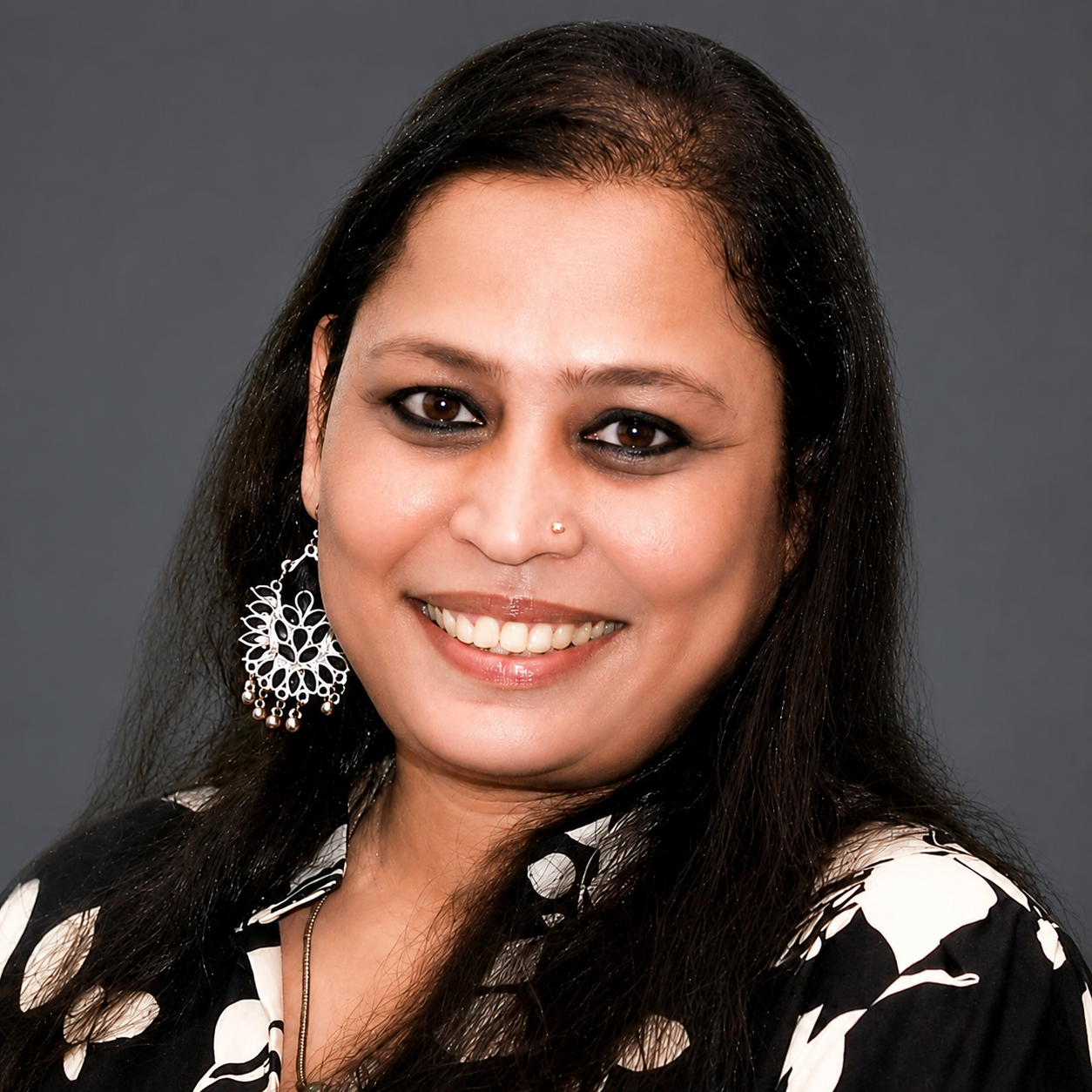
✦ SATYABHAMA MAJHI ✦
Contemporary Indian Artist • Curator • Social Activist • Community Art Practitioner
Where Art Meets People, Memory, Nature and the Living Culture of Odisha
“For Satyabhama Majhi, art is not merely something to be viewed—it is a way of understanding people, places, memory, nature and the relationships that shape our collective existence.”
Introduction
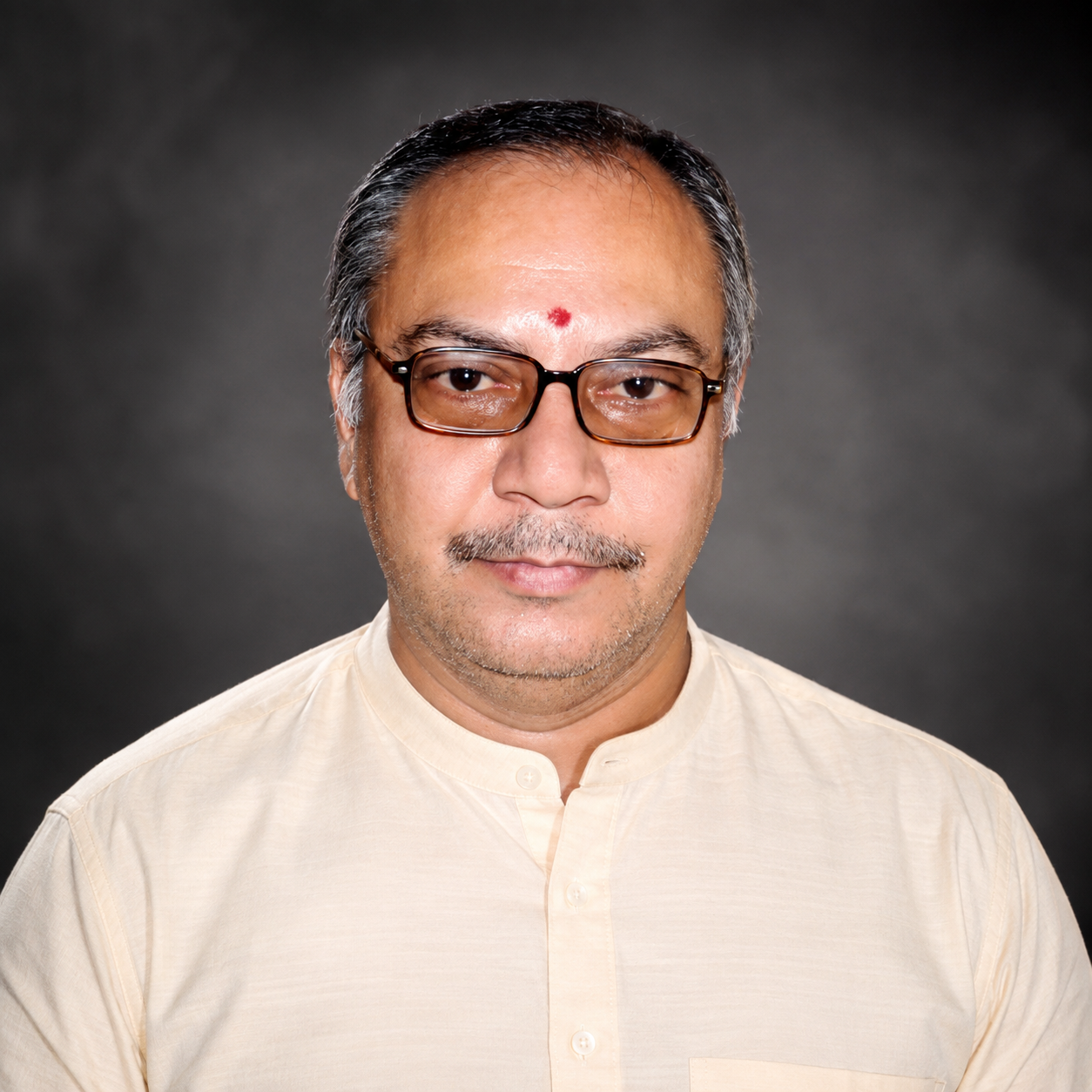
Satyabhama Majhi is a contemporary Indian visual artist, curator, social activist and community art practitioner based in Bhubaneswar, Odisha.
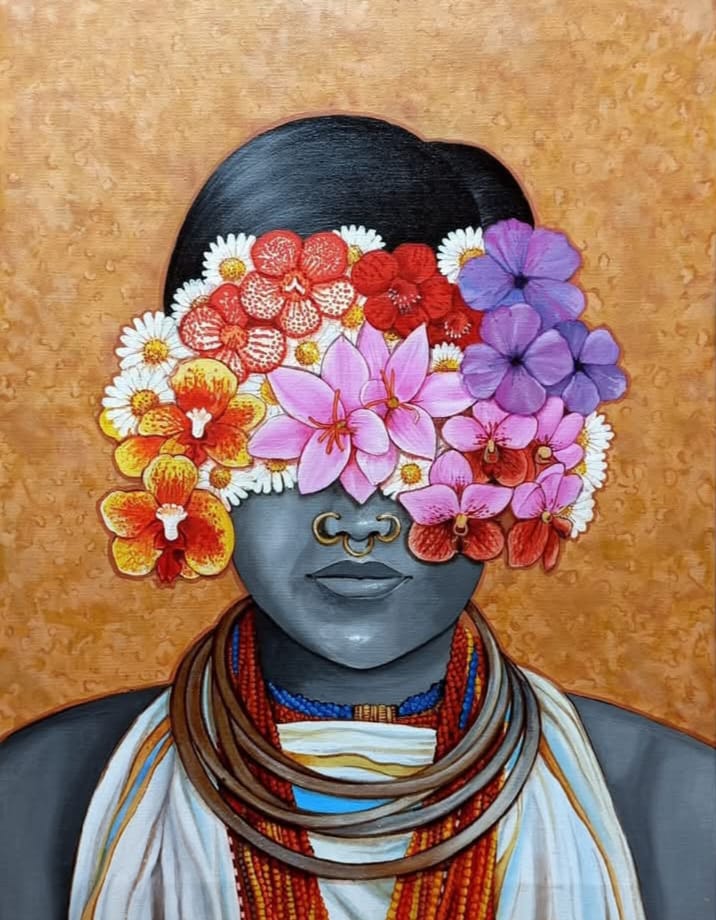
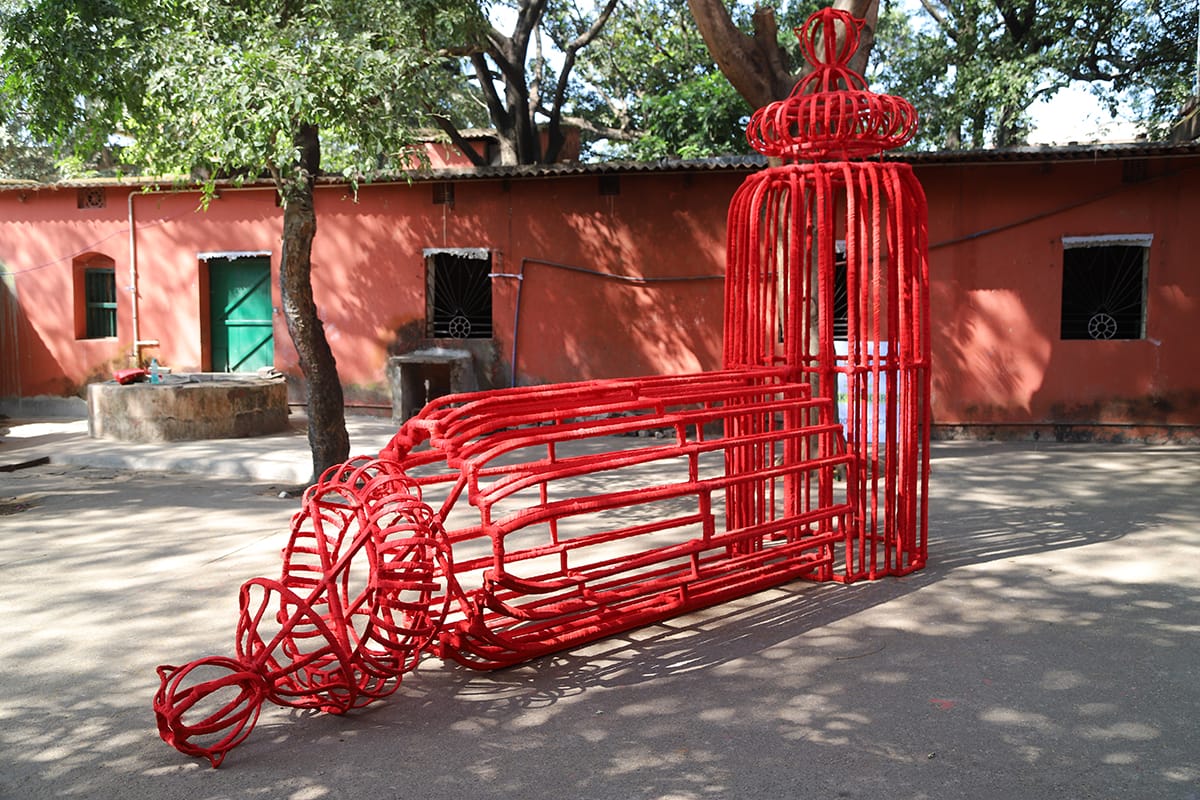
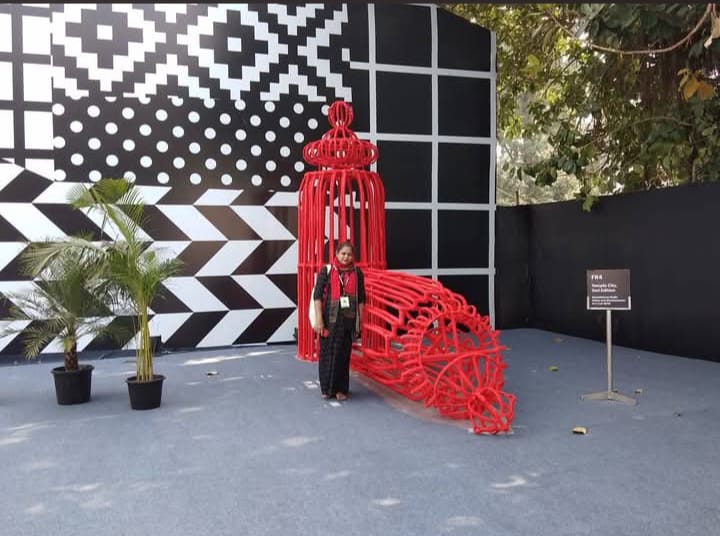
Working across painting, sculpture, installation art and photography, she has developed a distinctive artistic language rooted in observations of everyday life, rapidly changing urban environments, regional aesthetics, indigenous knowledge systems and human relationships with nature.
Her practice moves effortlessly between the intimate and the collective.
A busy marketplace, a changing city, a tribal settlement in the hills, a child discovering the freedom to express an idea on canvas, or an artisan carrying generations of visual knowledge—all become meaningful points of departure in her creative world.
Educated with an M.F.A. in Traditional Art, Satyabhama has spent years expanding the possibilities of art beyond galleries and conventional exhibition spaces. Her work brings together artistic experimentation, cultural documentation, community participation and social engagement.
Her career represents an important idea:
Art can preserve memory, strengthen communities and create deeper relationships between people and the world they inhabit.
An Artist Shaped by the City
One of the most important subjects running through Satyabhama Majhi’s artistic practice is the idea of the city.
For her, a city is not simply architecture, roads or infrastructure. It is a living accumulation of histories, memories, conversations, social transformations and everyday human encounters.
Her relationship with this subject is deeply personal.
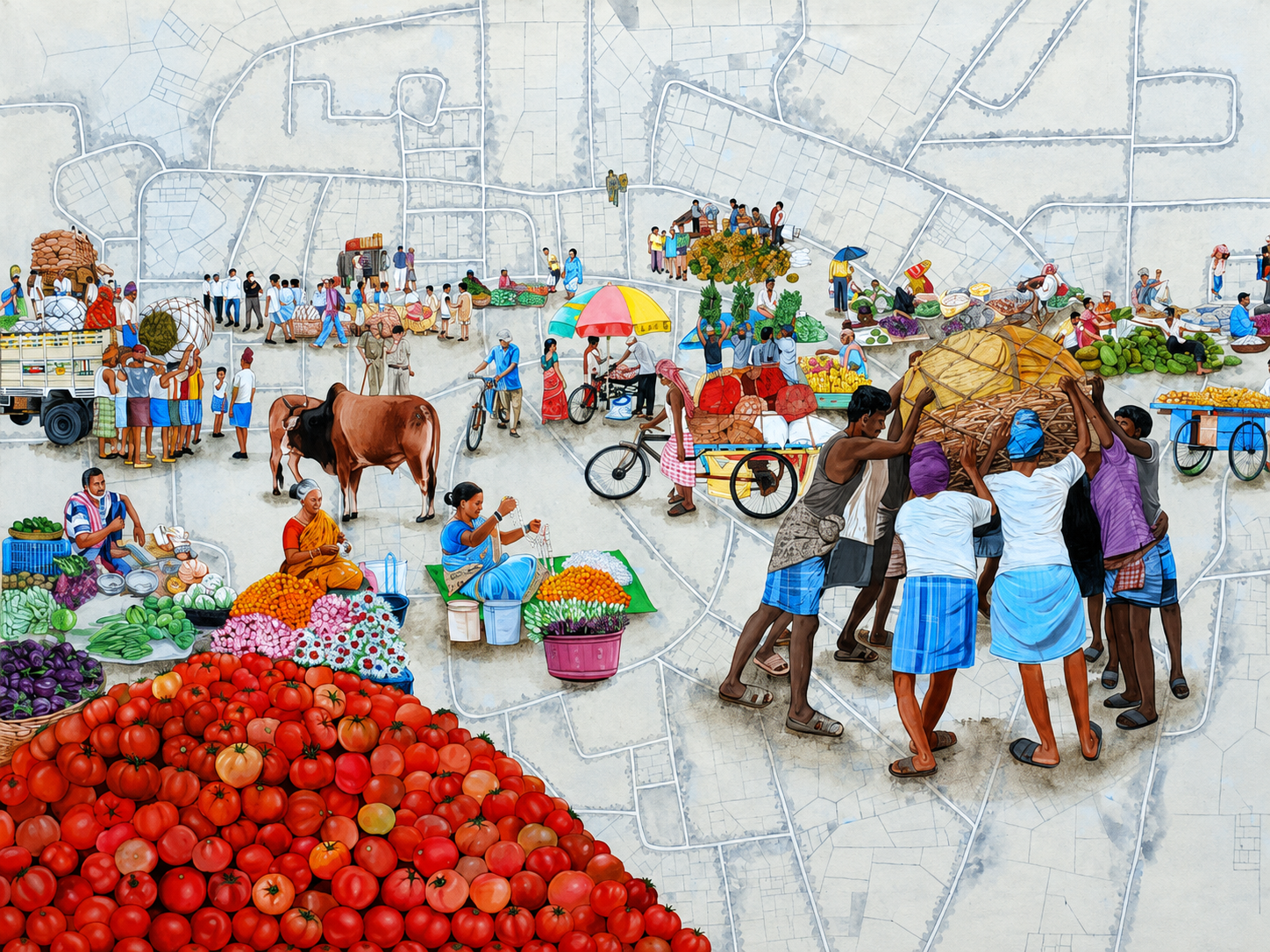
Growing up in Bhubaneswar, she closely observed the activities around her father’s shop in a local market. The marketplace became an informal classroom of human behaviour.
She witnessed people arriving for different purposes, seasonal celebrations unfolding, everyday buying and selling, relationships between people and animals, changing neighbourhood habits and even the transformation of the market after shops closed at night.
These apparently ordinary scenes gradually became central to her understanding of collective life.
Her portfolio describes how these experiences led her to question cultural and behavioural patterns, disappearing histories, memories attached to specific places and the effects of urbanization on local and regional spaces.
Bhubaneswar itself became part of this artistic enquiry.
The city she observed as a child has changed dramatically over the decades. Yet her father's shop remains within the same market—almost like a silent witness to the transformation occurring around it.
Through this perspective, Satyabhama does not merely document urban development.
She asks deeper questions:
What happens to memory when a city changes?
What remains when familiar spaces disappear?
How do communities negotiate modernization without losing their cultural character?
It is this sensitivity to transformation that gives her paintings of urban life their emotional and conceptual depth.
A Multidisciplinary Artistic Practice
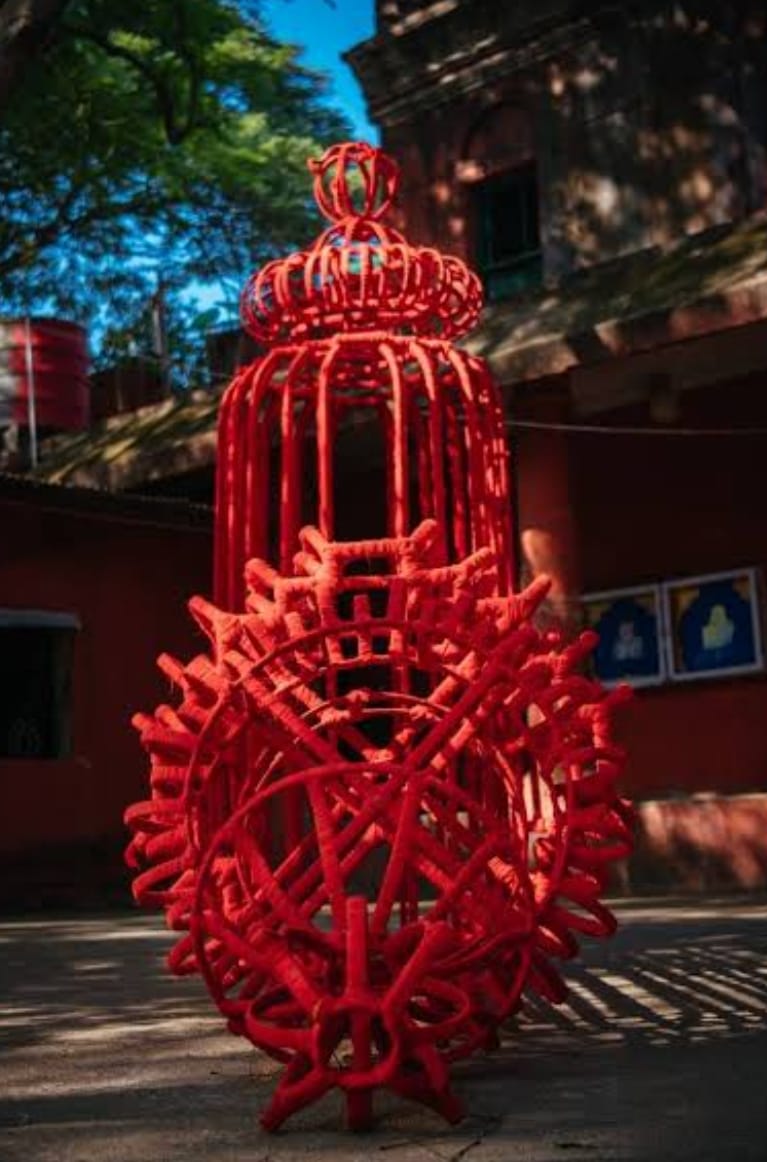
Although painting remains one of Satyabhama’s strongest forms of expression, her creative practice extends across several mediums, including:
-
Painting
-
Installation Art
-
Sculpture
-
Photography
-
Mixed Media
-
Public Art
-
Community-Based Art
-
Site-Specific Projects
-
Art Education and Creative Learning
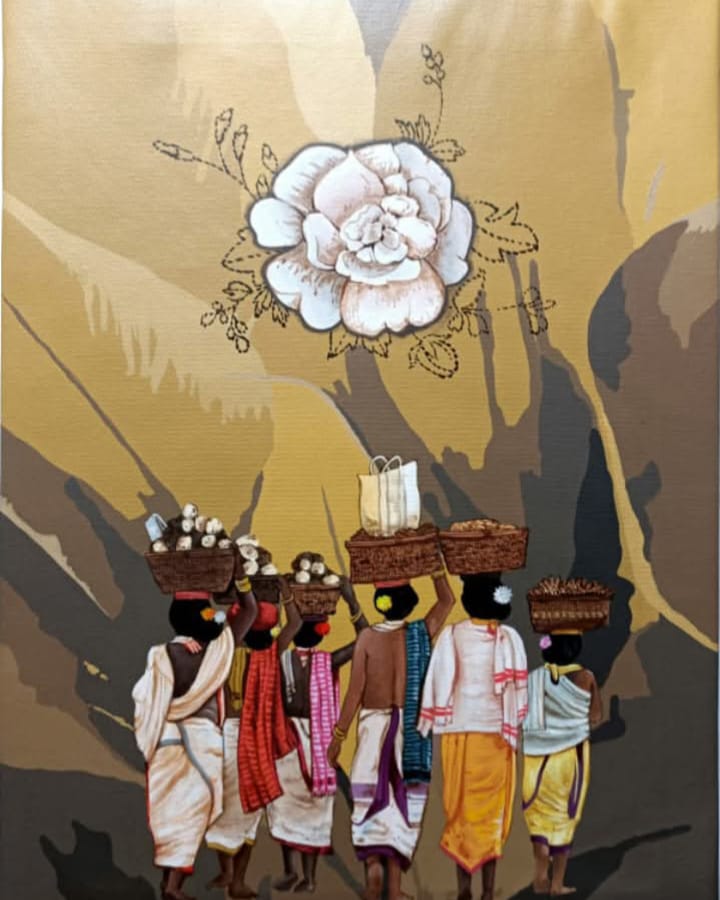
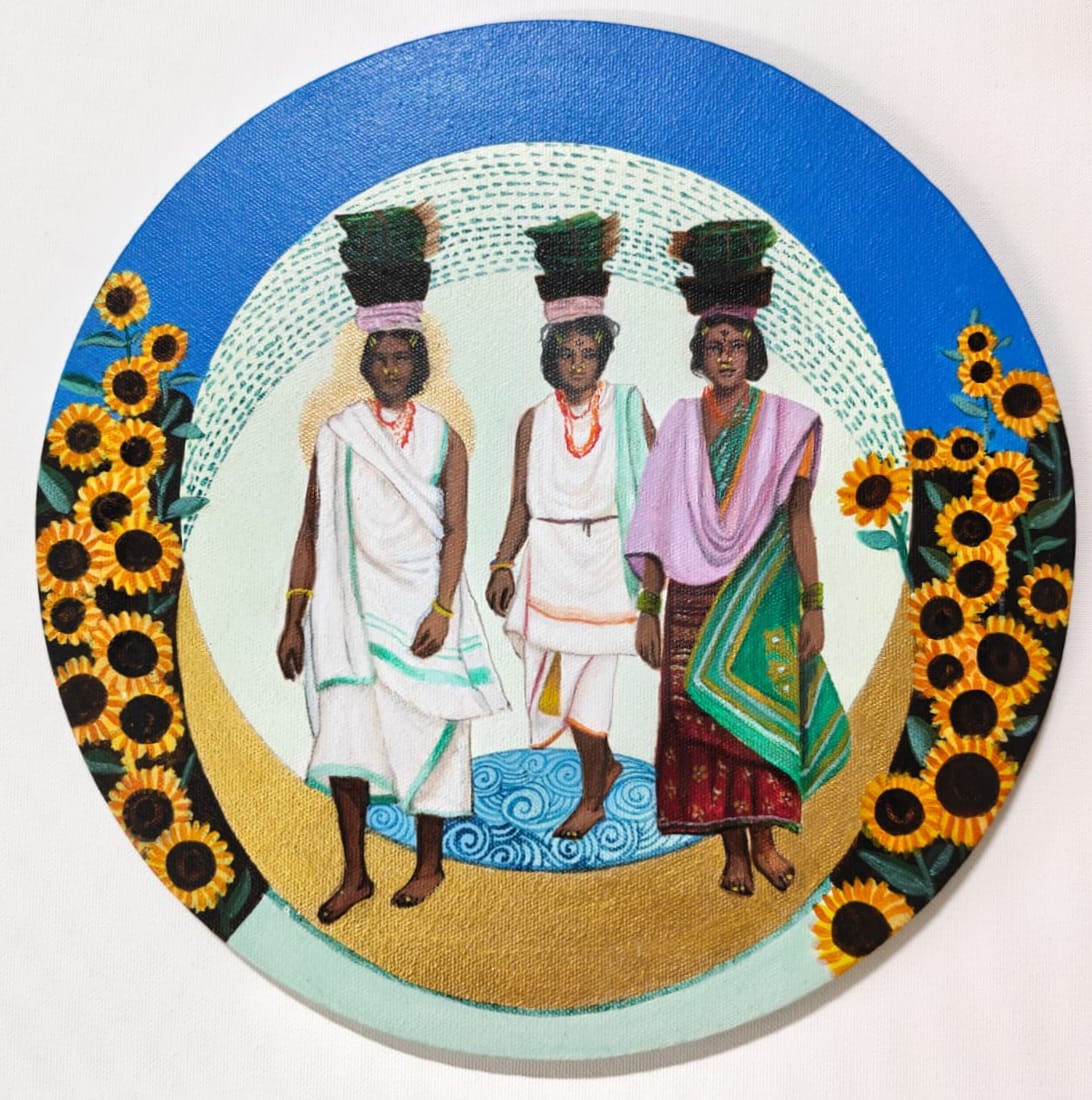
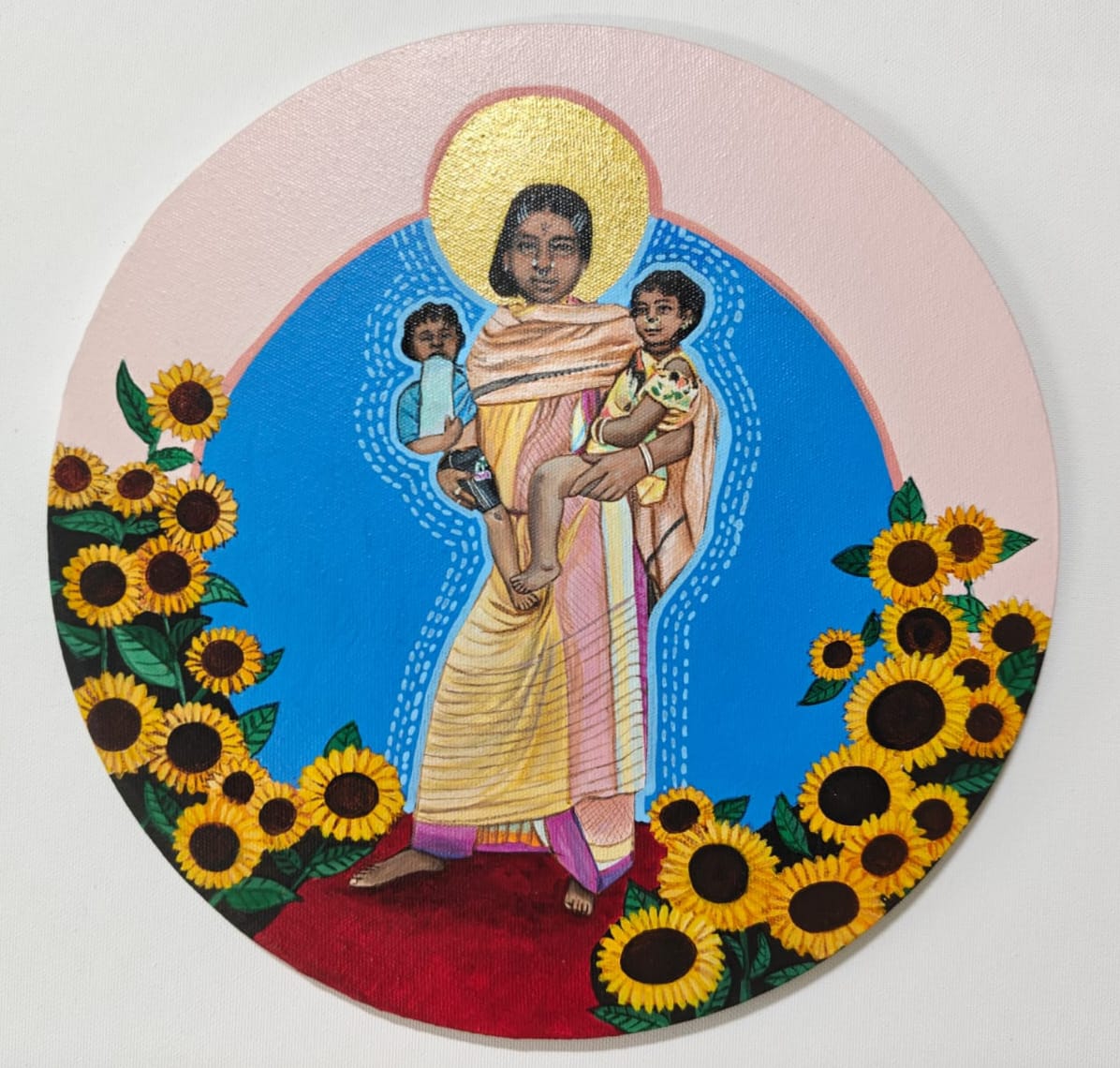
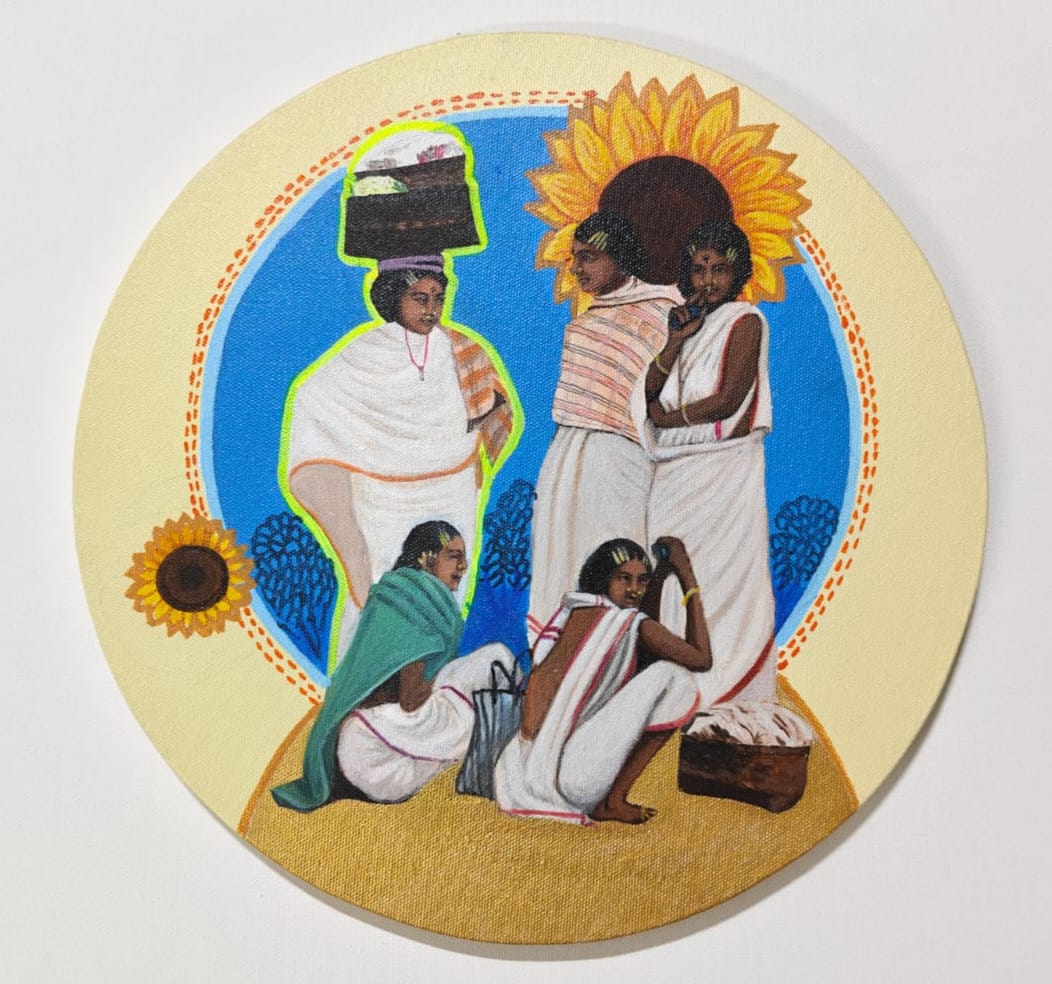
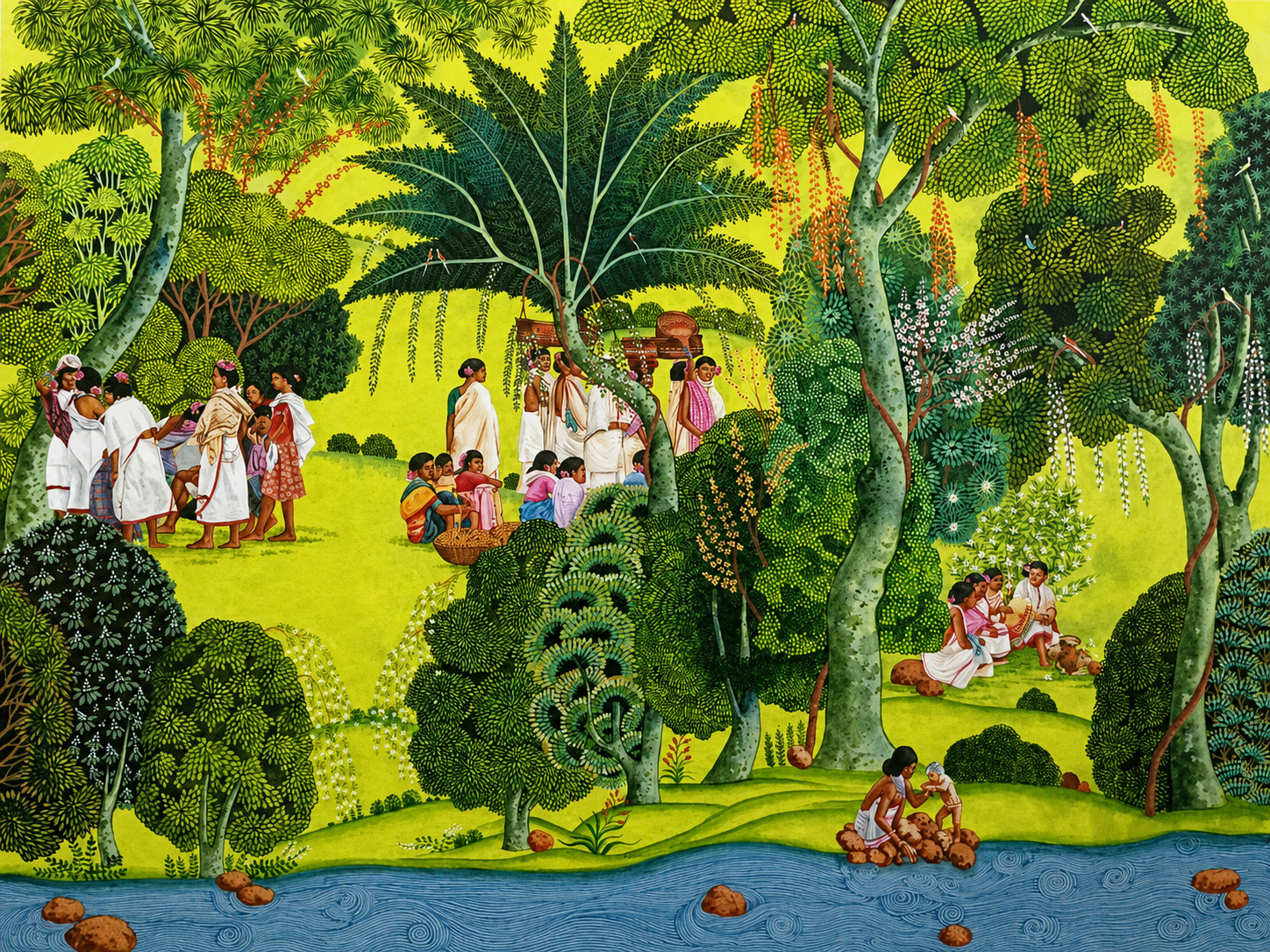
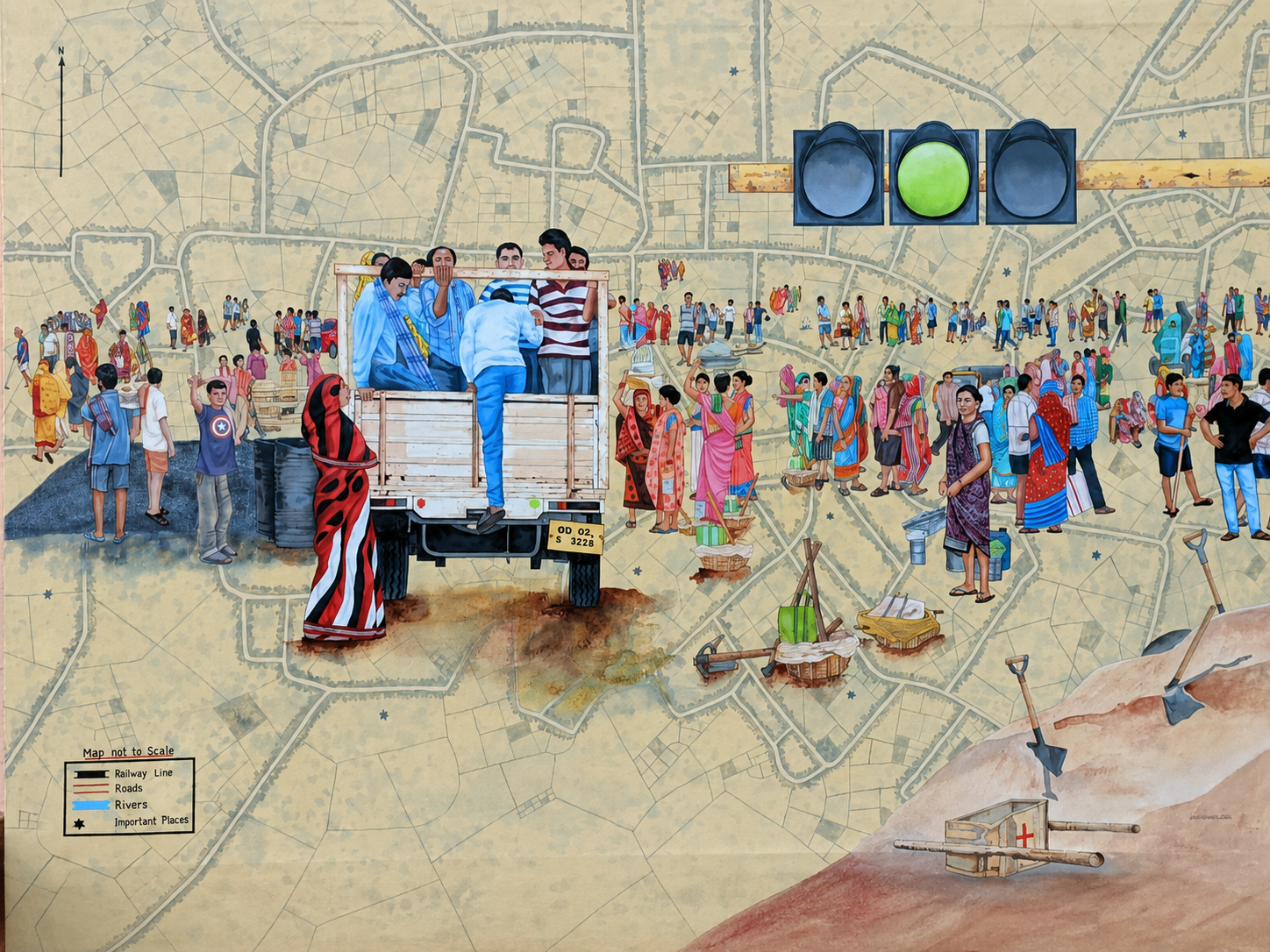
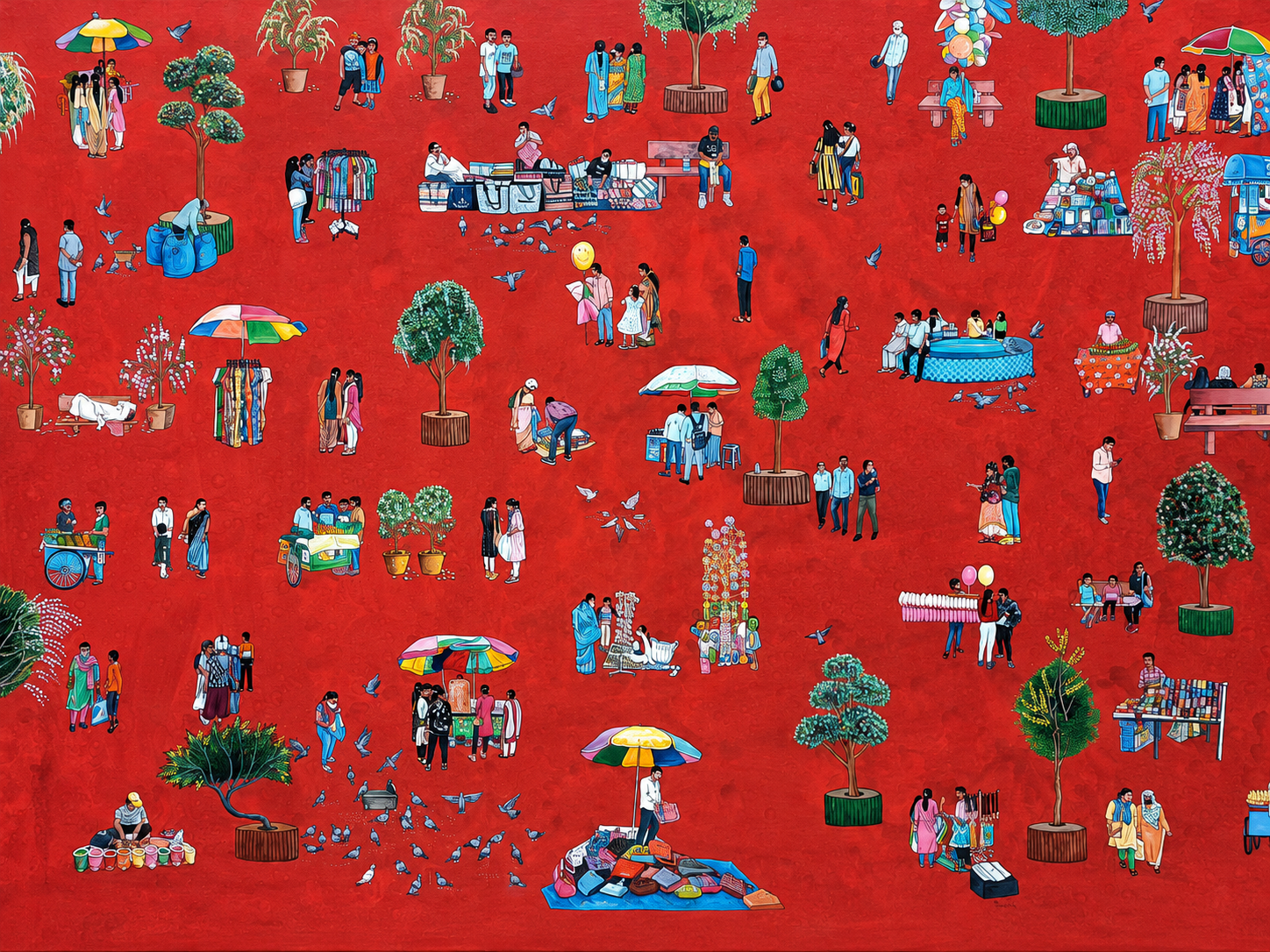
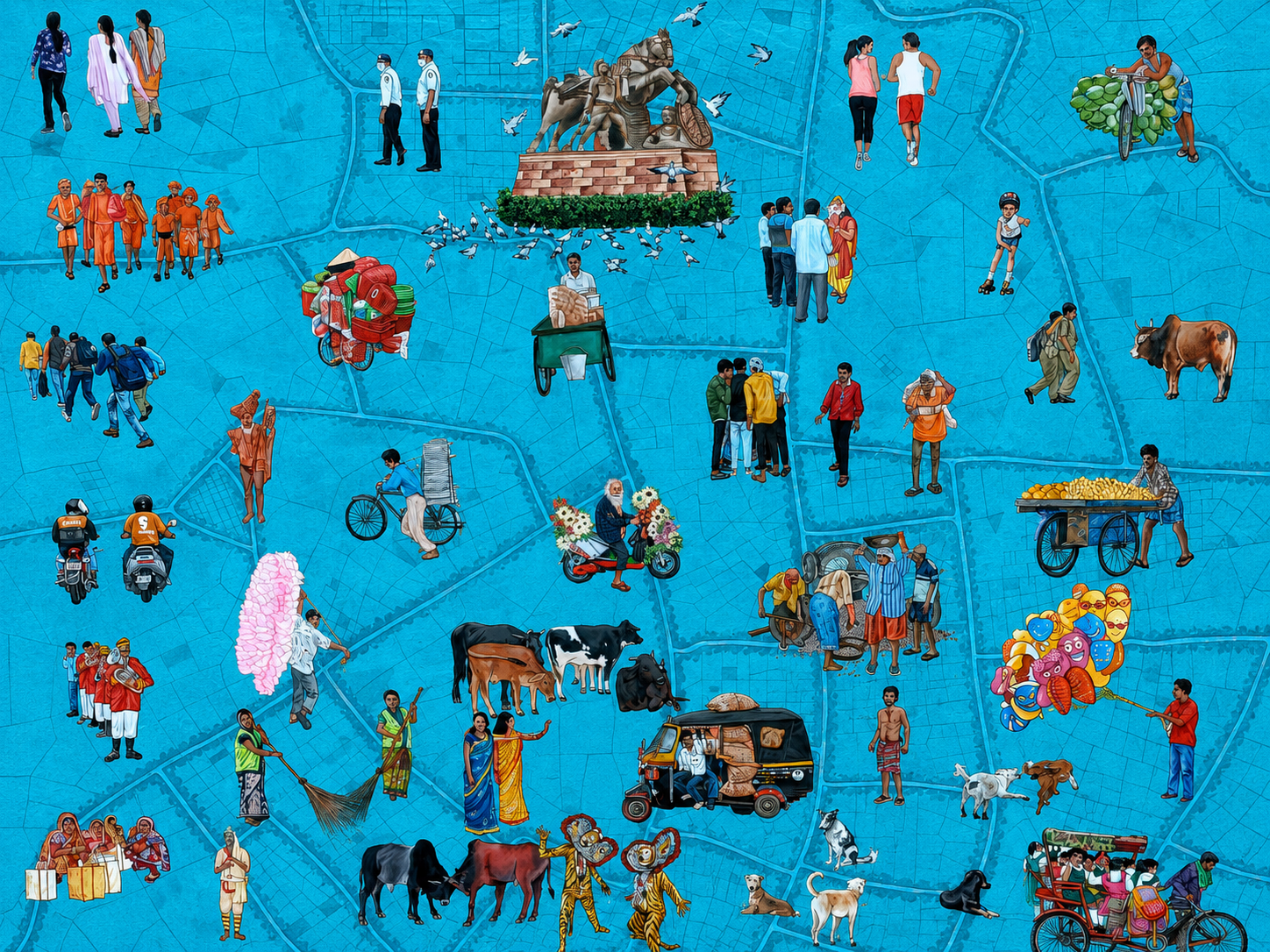
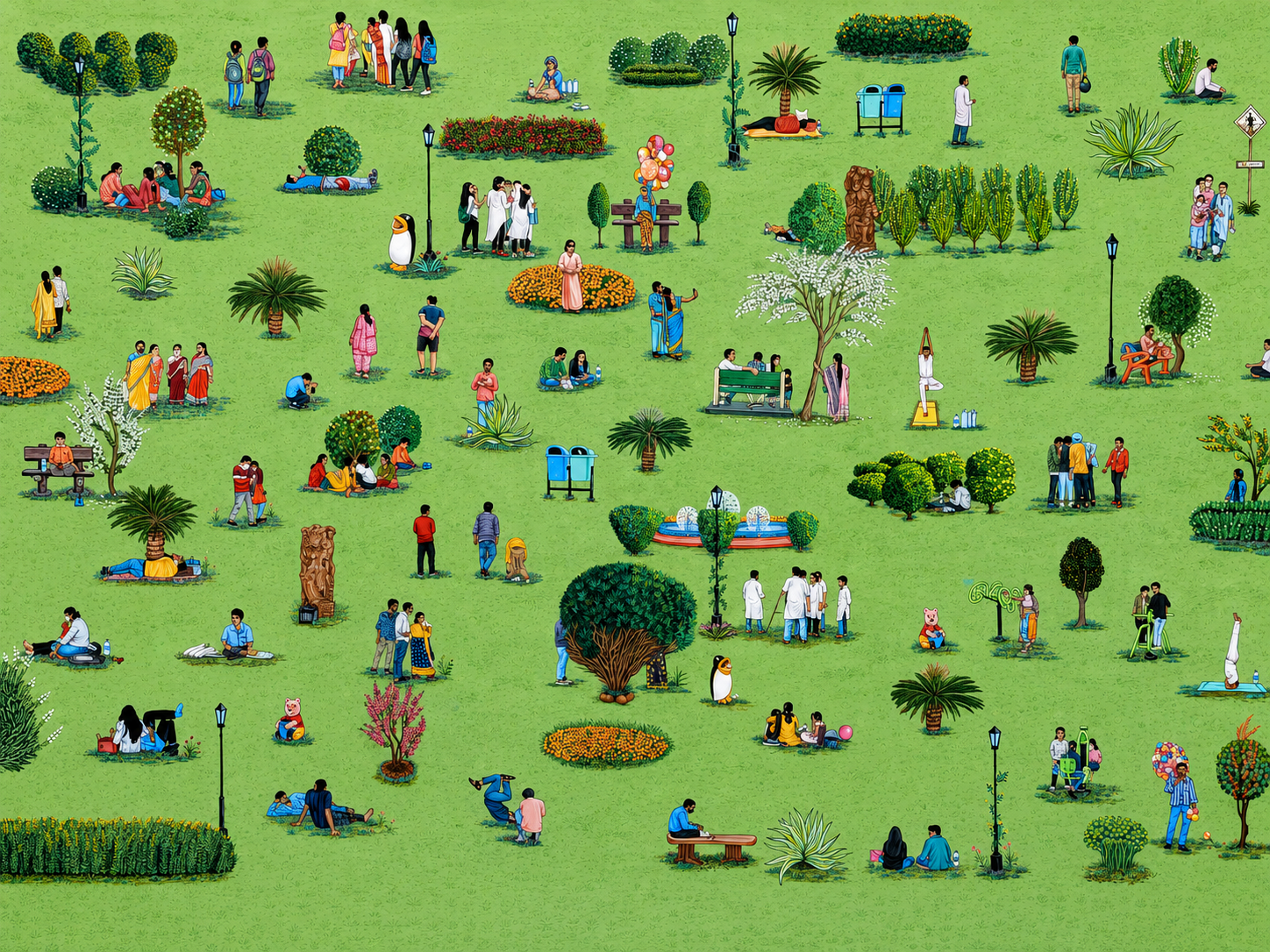
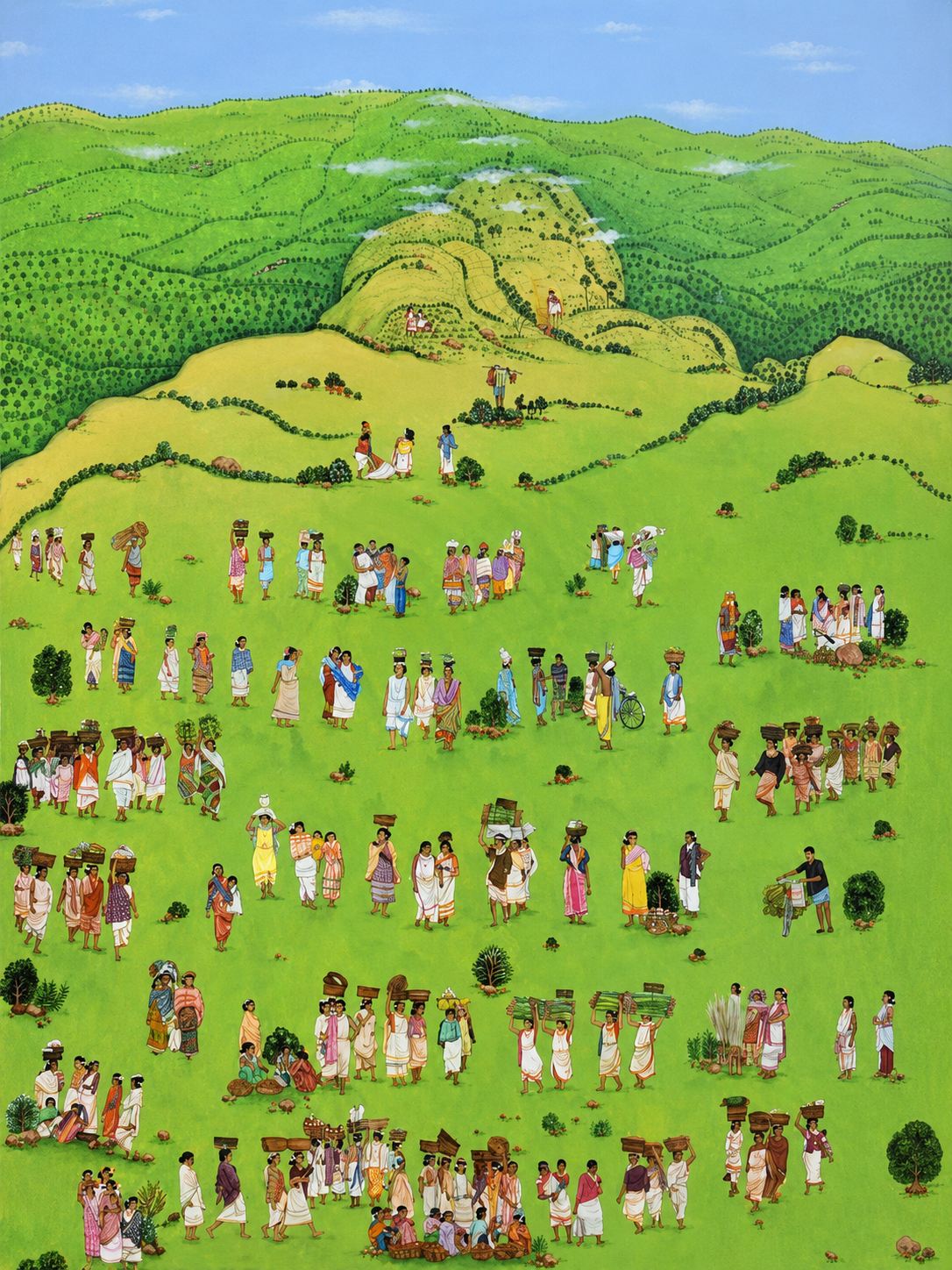
Her paintings often bring together numerous small human encounters within a larger visual landscape.
Rather than focusing only on a single protagonist, she allows entire communities to become the subject.
People meeting, walking, selling, waiting, celebrating, resting and interacting with their surroundings collectively create a visual rhythm.
Several works from her 2022 acrylic-on-canvas series demonstrate this approach, presenting expansive compositions populated by people, vegetation, vendors, animals, architecture and fragments of everyday urban life.
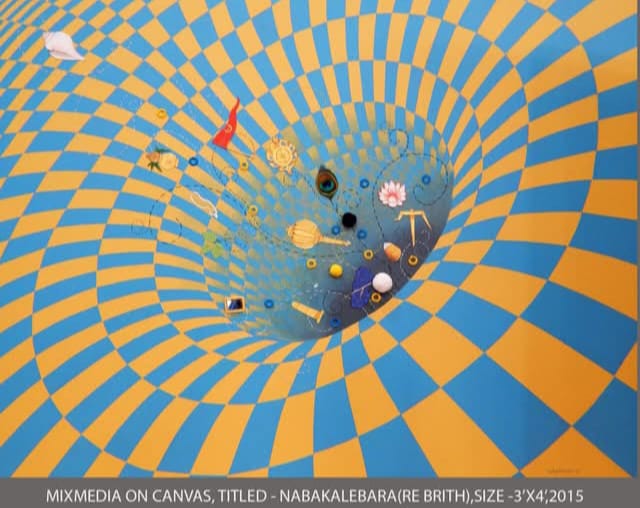
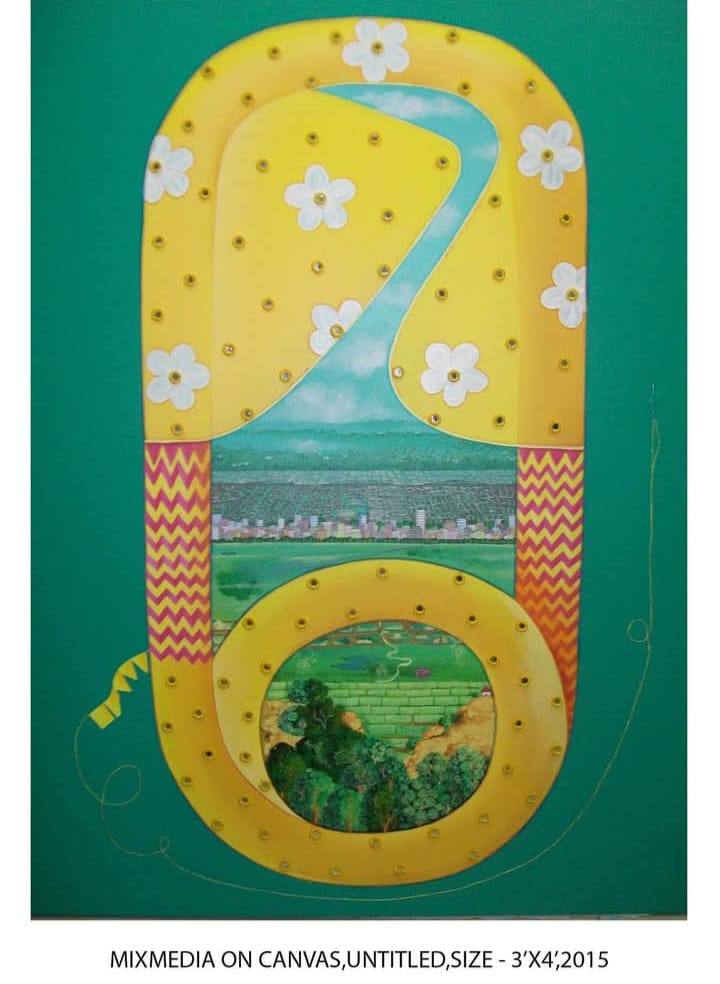
Her 2021–22 mixed-media works on paper, meanwhile, explore recurring visual elements such as triangular forms, people, animals, plants, domestic imagery and culturally rooted patterns.
Together, these works demonstrate an artist interested not merely in depicting a place, but in understanding the networks of relationships that make a place meaningful.
The Dongaria Kondh and a Decade of Cultural Engagement
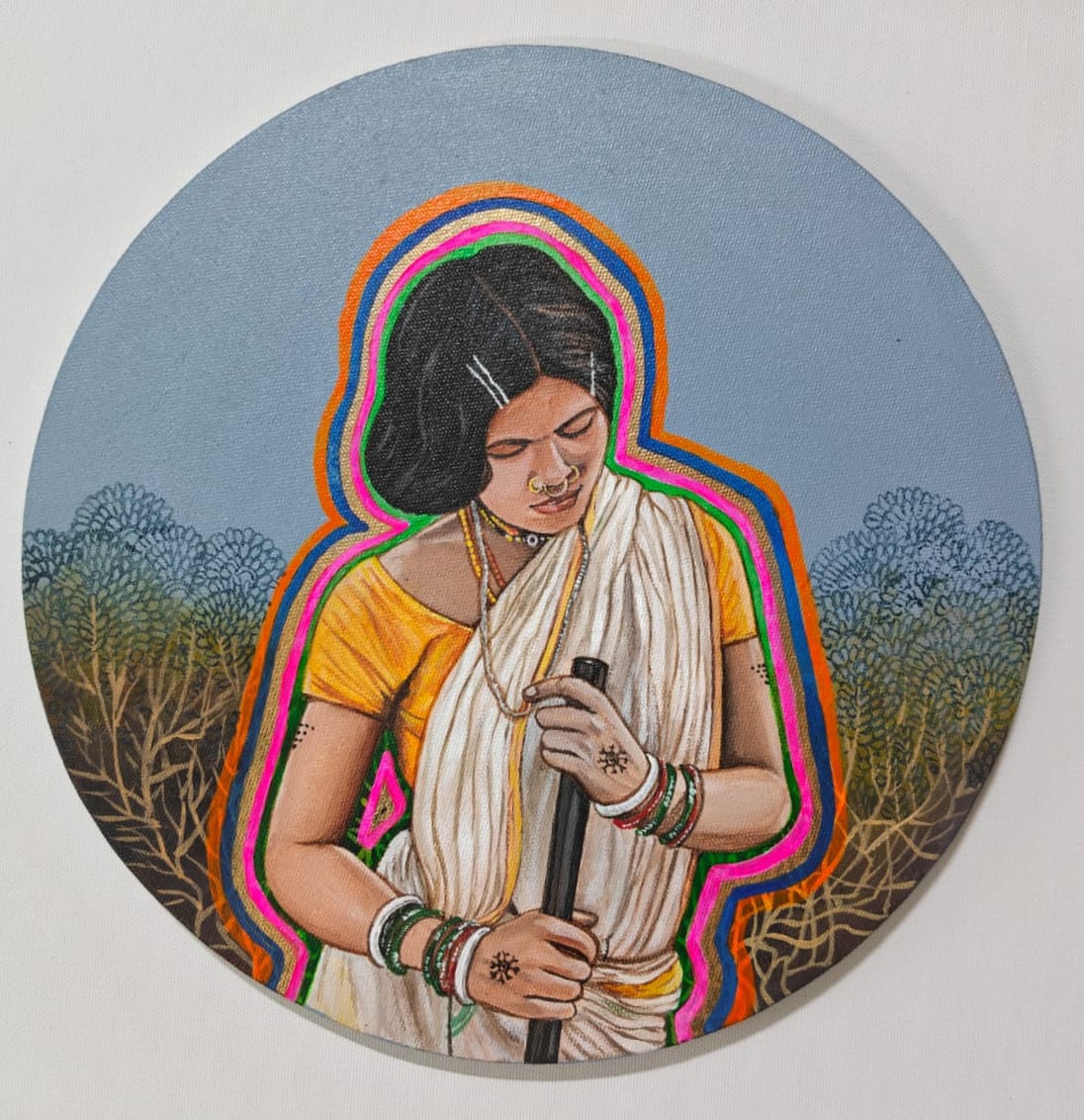
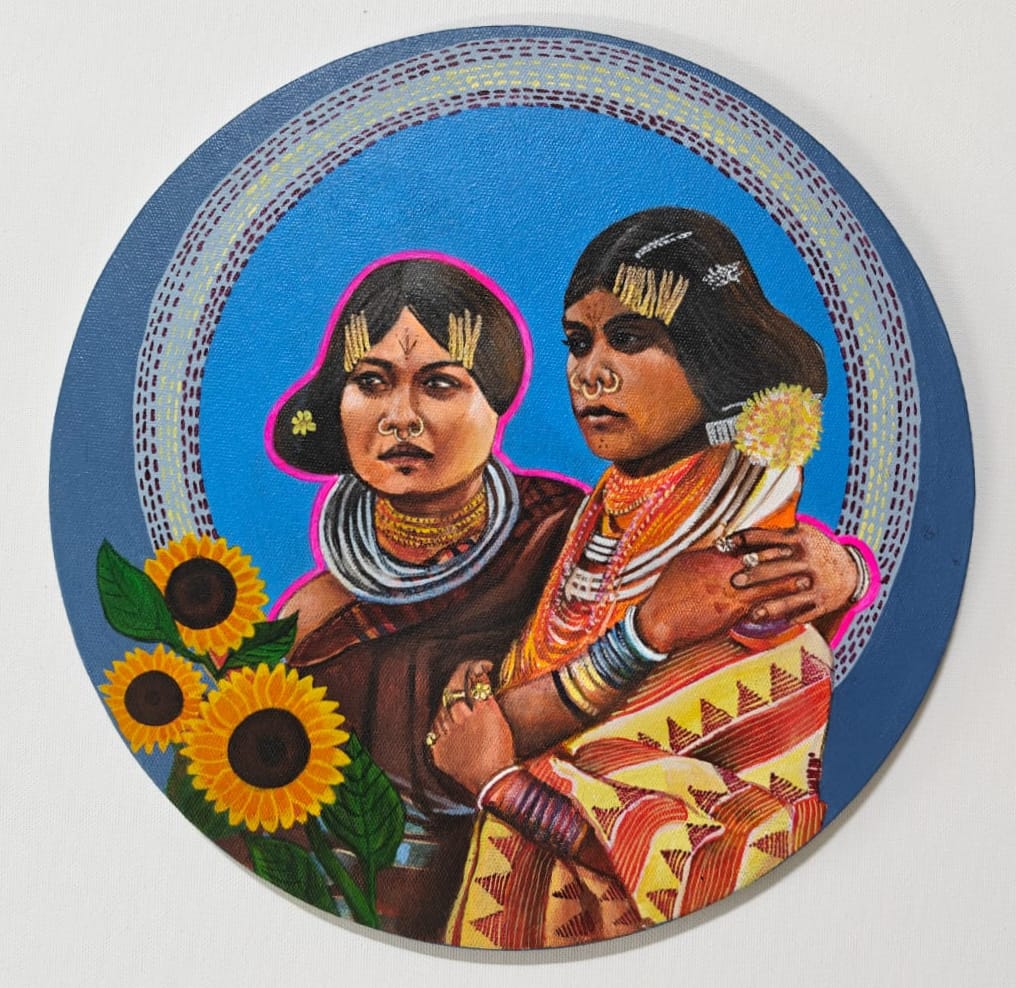
Among the most significant dimensions of Satyabhama Majhi’s artistic journey is her sustained engagement with the Dongaria Kondh community of Odisha.
This relationship developed not as a brief artistic subject but through years of observation, interaction and learning.
Her own portfolio records an engagement with the community extending for more than a decade, undertaken to better understand their cultural practices, livelihood and close relationship with nature.
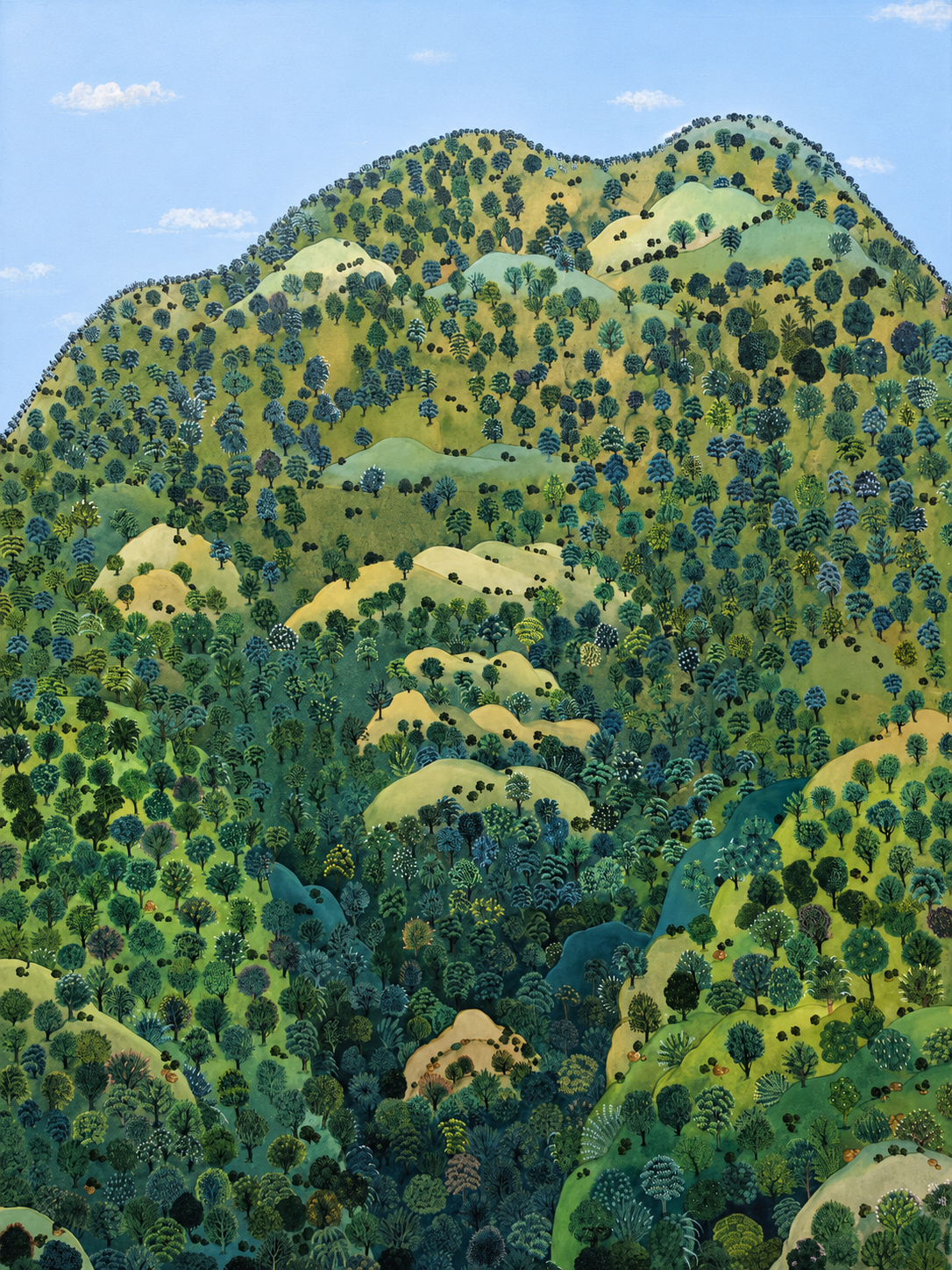
For Satyabhama, the Dongaria Kondh way of life offered a profoundly different way of understanding landscape.
In the Niyamgiri hills, nature is not merely scenery.
It is livelihood.
It is memory.
It is spirituality.
It is identity.
And it is an essential participant in everyday existence.
Her artistic exploration became particularly connected with the tribe’s visual traditions and their reverence for Niyam Raja, the sacred force associated with the Niyamgiri landscape.
Painting with the Earth of Niyamgiri
One of the most powerful aspects of Satyabhama’s exploration of Dongaria Kondh visual culture has been her engagement with the natural materials found within their environment.
Inspired by traditional practices in which homes become living surfaces for artistic expression, she studied wall paintings, indigenous visual motifs and the community’s relationship with naturally sourced colours.
Rather than simply reproducing their aesthetic vocabulary using conventional studio materials, she sought a more direct relationship with the land itself.
From the Niyamgiri region, she collected natural materials including:
chalk stone, charcoal, turmeric, geru soil and brown stone.
These materials were transformed into pigments and combined with a binding medium to create colours physically originating from the landscape.
The process gave the act of painting another meaning.
The earth was no longer simply represented in the artwork.
The earth became part of the artwork.
Through this approach, material, landscape and cultural memory came together within a single artistic process.
The Triangle — Landscape, Stability and Divinity
A recurring form within Satyabhama Majhi’s work inspired by Dongaria Kondh visual culture is the triangle.
Within her exploration, the triangular form becomes connected with the silhouette of the Niyamgiri hills and ideas of stability, sacred geography and divinity.
Rather than treating the triangle simply as a geometric shape, she allows it to function as a cultural and philosophical vocabulary.
Repeated triangles create mountains.
Mountains become landscapes.
Landscapes become memory.
And memory becomes a way of understanding an entire community’s relationship with its environment.
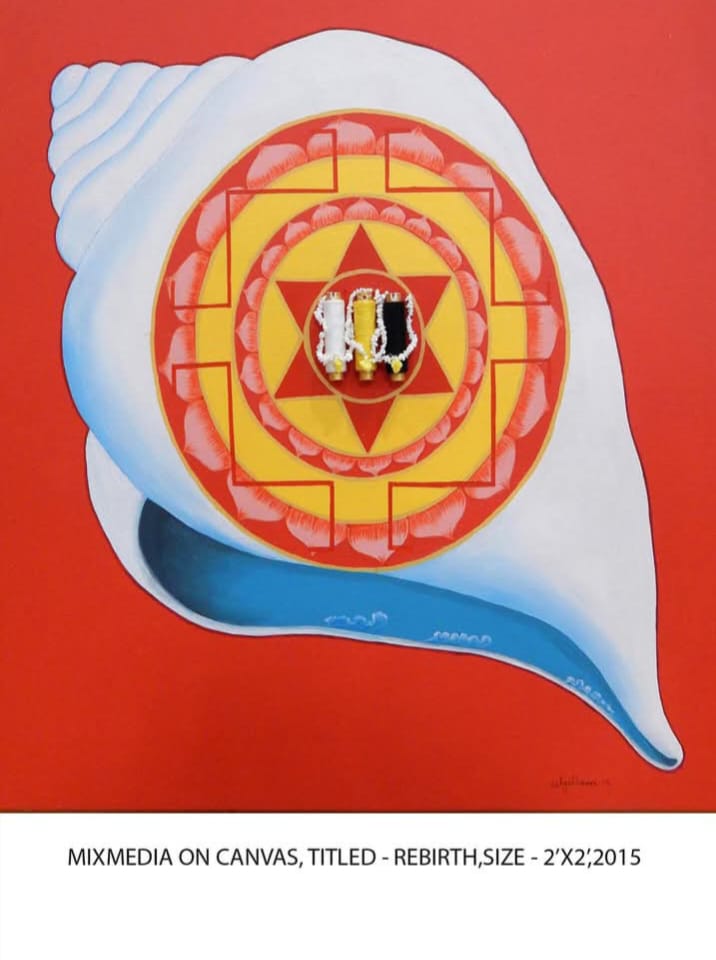
This motif appears repeatedly throughout her mixed-media works, sometimes as dominant geometric structures and sometimes woven together with images of people, animals, plants and scenes of everyday life.
By bringing together traditional colours, culturally resonant symbols and contemporary artistic composition, her work creates a visual bridge between indigenous knowledge and contemporary art.
“Up and Down” — Art Inspired by Everyday Movement
Satyabhama’s observation of Dongaria Kondh life also led to one of the most evocative conceptual ideas within her practice:
“Up and Down.”
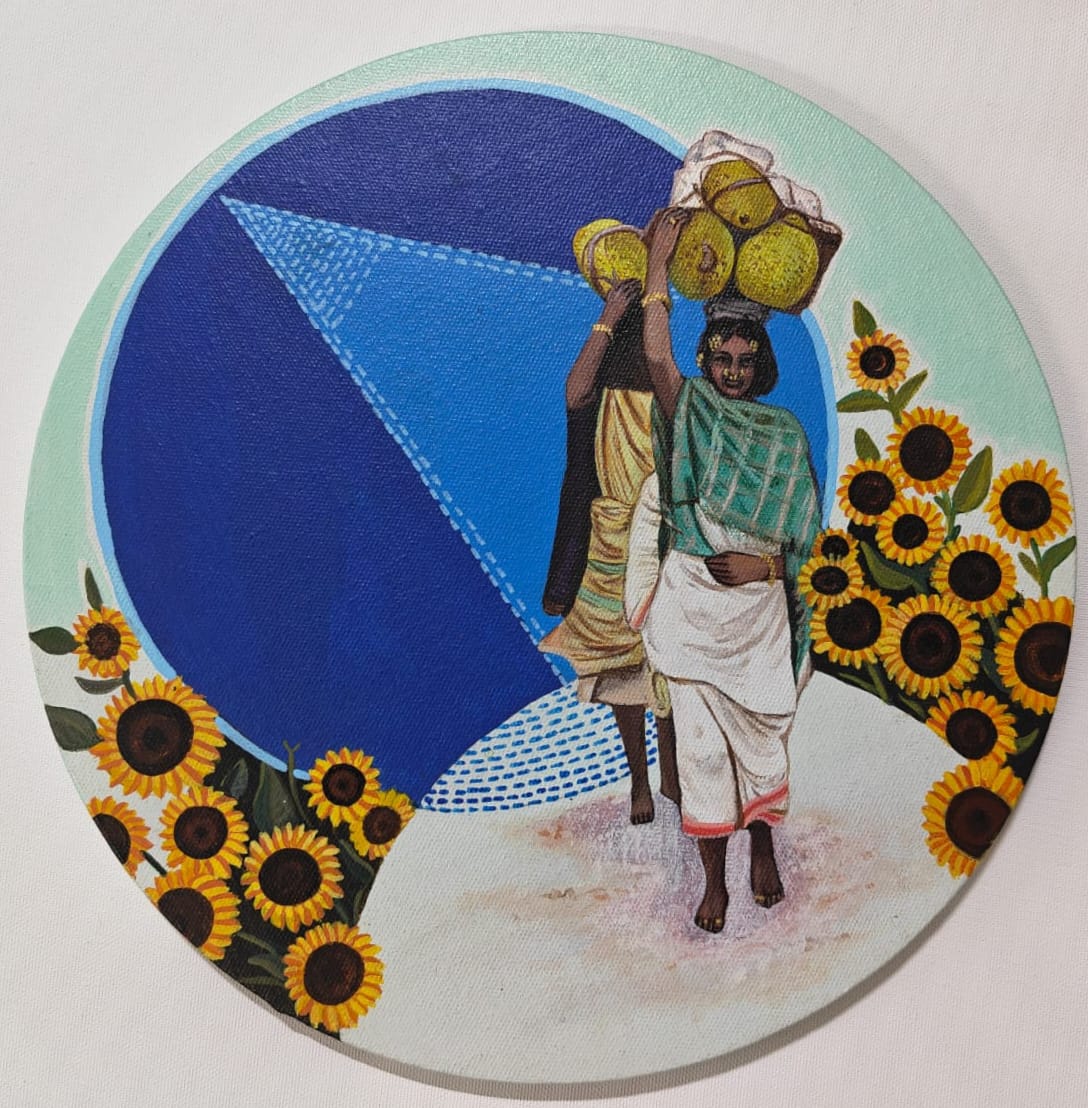
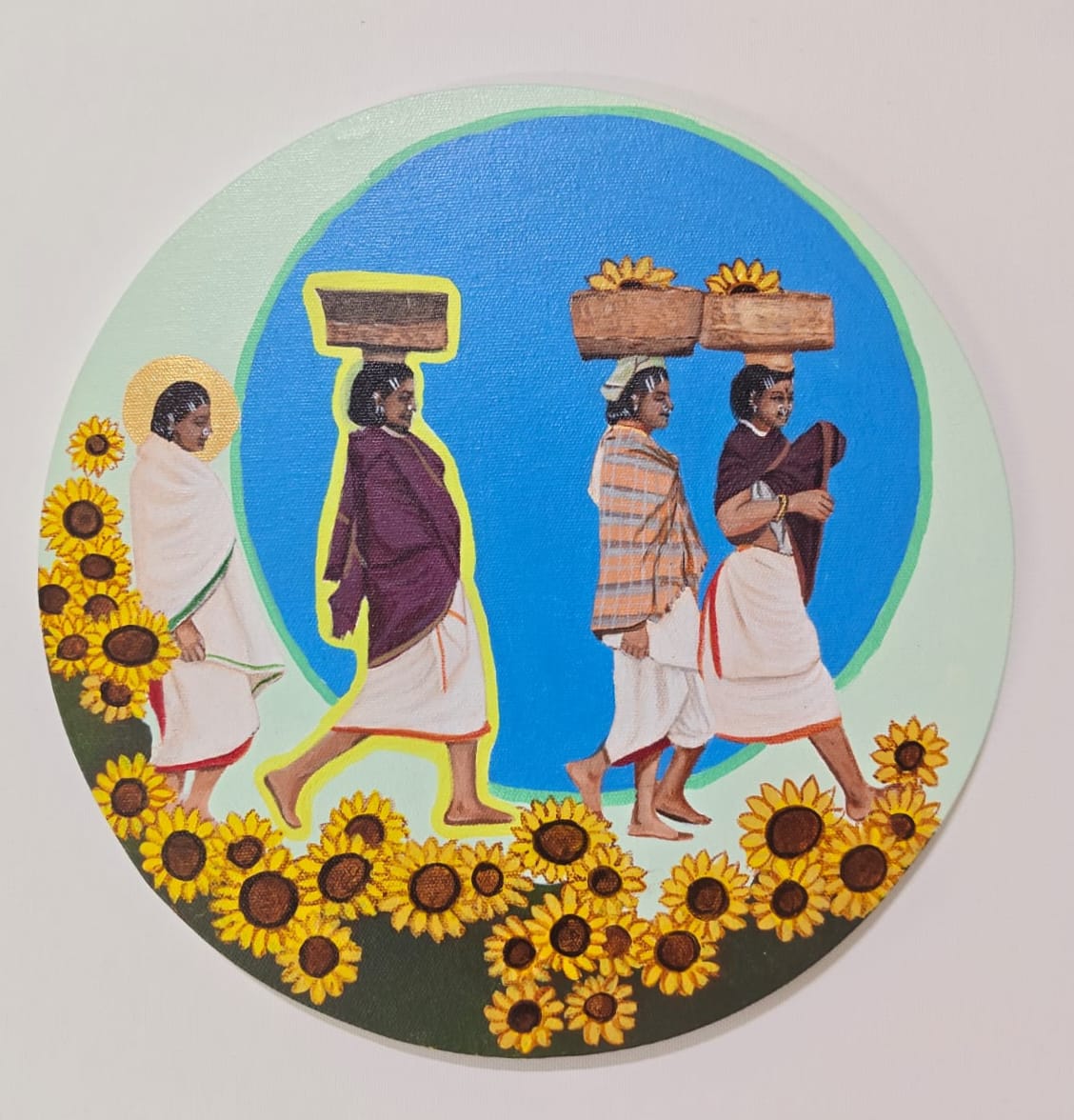
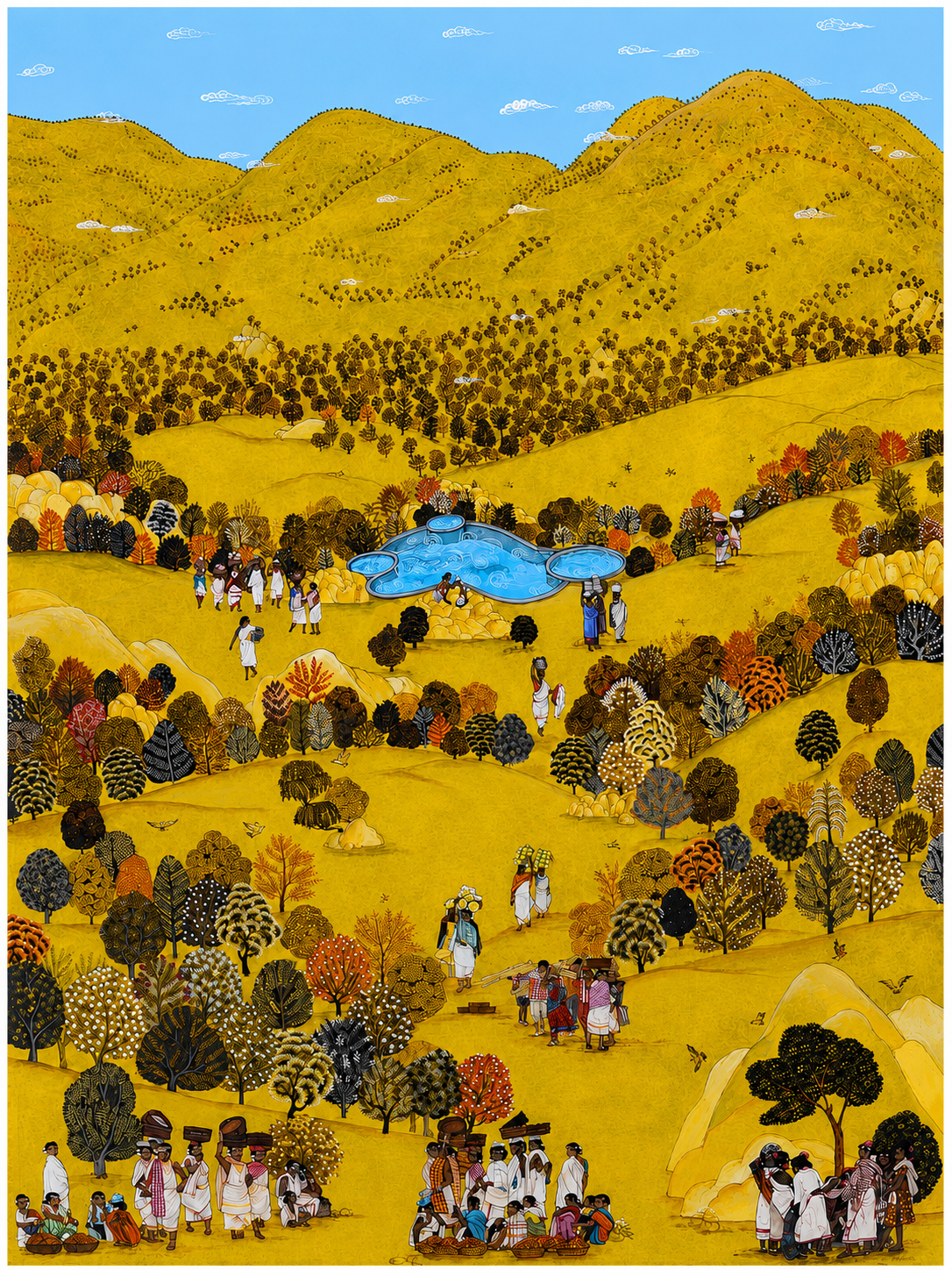
Life in the hills involves continual movement.
People travel uphill and downhill as part of their daily routines, livelihoods and relationship with the landscape.
Satyabhama began to see this movement as more than physical travel.
It became a metaphor for life itself.
Her portfolio describes how the everyday journey of the community inspired her to consider the contrasts between urban struggles and tribal life while examining how different communities continually move in pursuit of a better existence.
This perspective reflects an important characteristic of her practice.
She does not attempt to isolate tribal communities as exotic subjects.
Instead, she searches for shared human experiences across geographic and social boundaries.
People’s Wall — Jan, Janani and Janmabhumi
One of the defining national-level projects associated with Satyabhama Majhi is “People’s Wall – Jan, Janani and Janmabhumi,” created for India’s New Parliament House.
In 2023, she served as a Co-Sutradhar and key creative contributor to the participatory project involving women artists and artisans from different regions of India.
The project was realized for the New Parliament House through Lalit Kala Akademi, New Delhi.
The initiative brought regional aesthetics, traditional visual languages and the creative knowledge of women practitioners into one of the country’s most symbolically important public spaces.
Its significance extended beyond the creation of an artwork.
It represented participation.
It represented collective cultural memory.
And most importantly, it created space for women artists and artisans from different parts of India to contribute their visual traditions to a work connected with the democratic identity of the nation.
For Satyabhama, whose career has repeatedly connected professional artistic practice with community participation, the project represented a powerful convergence of many ideas that had shaped her work for years.
Public Art and the Transformation of Shared Spaces
Satyabhama Majhi has never viewed art as something that must remain confined within museums or galleries.
Public spaces are equally important to her practice.
Across Odisha, she has been involved in large-scale murals, public-art interventions and community projects designed to transform everyday spaces.
Her work has contributed to the visual transformation of urban locations including Ring Road and the Dagabara Sahi area of Cuttack, along with several public-art initiatives in Bhubaneswar and other parts of Odisha.
Her documented projects include wall murals associated with major public occasions, including the World Men’s Hockey Cup and the Asian Athletics event, as well as public-art projects such as Pago and Thought Loom.
For her, a wall is more than a physical boundary.
It can become a story.
A neighbourhood can become a gallery.
And a public space can become a shared cultural experience.
Art as a Tool for Education
Another major dimension of Satyabhama Majhi’s life has been her work with children.
For approximately 15 years, she has engaged with school children and educational communities, encouraging learning processes in which creativity becomes an important part of education.
Her approach moves away from the idea that children must simply imitate predetermined images.
Instead, creative learning becomes a process of observing, remembering and transforming their own experiences into visual expression.
Through programs such as Kalpanadham, and through collaborations with organisations including Gram Vikas and Tata Trust, she has worked with children, including those in tribal communities, helping them translate everyday experiences into art.
A household routine.
A tree.
A village journey.
A festival.
An animal.
A memory.
An ordinary day.
Each can become material for artistic discovery.
This method helps children understand that creativity does not exist somewhere distant from their lives.
Their own lives are already full of stories worth expressing.
Her CV records extensive workshops with residential schools, children’s festivals and educational initiatives across Odisha, alongside earlier workshops involving children with disabilities and children from underserved communities.
Social Engagement and Sasatwa Foundation
Satyabhama Majhi also serves as Secretary of the Sasatwa Foundation, through which her engagement with art intersects with wider social and community concerns.
Her philosophy of social practice is based less on intervention from a distance and more on creating relationships.
She spends time with communities.
She observes.
She listens.
She learns from existing traditions.
Only then does art enter the conversation.
This approach has taken her into villages, schools, tribal communities, urban neighbourhoods and public spaces.
Her work with indigenous communities, particularly the Dongaria Kondh, reflects her belief that meaningful artistic engagement can develop greater empathy between people while reconnecting society with ecology, memory and local knowledge.

Exhibitions, Residencies and Artistic Engagements
Over the years, Satyabhama Majhi’s work has travelled through a wide range of exhibitions, camps, residencies, public-art projects and workshops.
Her artistic journey includes presentations and engagements at significant institutions and platforms such as:
Bharat Bhavan, Bhopal
Nature Morte, Gurgaon
New Delhi gallery platforms including Nvya
Lalit Kala Akademi
Odisha Lalit Kala Akademi
Bhubaneswar Art Trail
Vancouver Biennale-linked projects
Gram Art Project
and numerous national and regional artist camps.
Her CV records a solo show at Bharat Bhavan and participation in a group exhibition at Nature Morte, Gurgaon, alongside numerous national camps, public-art projects, residencies and exhibitions spanning more than two decades.
She has participated not only in conventional exhibitions but also in projects where artists worked directly within villages and communities.
These include the Gram International Residency, Gram Art Residency, the Vancouver Biennale “I HAVE A DREAM” project, and collaborations involving tribal women and rural communities.
These experiences helped shape an artistic practice in which the distinction between studio, community and landscape becomes increasingly fluid.
Lalit Kala Akademi Recognition
Among the important recognitions of her artistic career is the State Award of the Odisha Lalit Kala Akademi, which her professional profile records as having been received in 2012.
She was also awarded a National Lalit Kala Akademi, New Delhi Scholarship for 2009–2010, further marking an important stage in her professional development.
For Satyabhama, however, recognition exists alongside a much broader understanding of artistic responsibility.
Awards may mark milestones in an artist's career, but the real continuity of her work can be found in the relationships she has developed—with cities, communities, children, indigenous cultures and natural landscapes.
More Than Two Decades of Creative Practice
Satyabhama Majhi’s documented artistic activity stretches back to the early 2000s.
Her professional record includes exhibitions, workshops, artist camps, public-art interventions, educational initiatives and community projects from 2000 onward.
This continuity is significant.
Across changing artistic movements and changing urban environments, the questions within her work have remained deeply human:
How do people belong to places?
How does a landscape shape culture?
What happens when development changes familiar environments?
How can traditional knowledge coexist with contemporary life?
And how can art create empathy rather than simply representation?
These questions connect the many different dimensions of her career.
Art, Ecology and Indigenous Knowledge
Satyabhama’s artistic relationship with tribal communities is also deeply ecological.
The indigenous communities she works with do not generally separate culture from landscape in the way modern urban life often does.
Food, agriculture, ritual, colour, architecture, seasonal movement and spiritual belief remain closely tied to the natural environment.
Satyabhama’s engagement with such communities has therefore gradually become an enquiry into relationships between:
people and nature,
tradition and development,
memory and modernization,
local identity and global change.
Her work does not attempt to provide simplistic answers.
Instead, it creates visual spaces in which these relationships can be experienced and reconsidered.
The Artist as Listener
Perhaps one of the most distinctive characteristics of Satyabhama Majhi’s practice is that she approaches art as a form of listening.
Before transforming an experience into an image, she spends time understanding the people and environments connected with it.
This is particularly evident in her long engagement with tribal communities.
The objective is not simply to borrow indigenous motifs.
It is to understand the worldview from which those motifs emerge.
The triangle, the mountain, the wall painting, the natural pigment or the daily journey through the hills gains meaning because each exists within a much larger cultural system.
This sensitivity gives her work an anthropological depth while remaining firmly grounded in contemporary visual-art practice.
Her Visual Language
Satyabhama Majhi’s visual language often combines:
Narrative figuration — depicting everyday human activities and relationships.
Repetition — using multiple people, objects and motifs to create collective rather than individual narratives.
Geometry — particularly triangular forms associated with landscape and indigenous visual traditions.
Natural imagery — plants, hills, animals and ecological forms.
Regional memory — drawing upon Odisha's environments and cultural traditions.
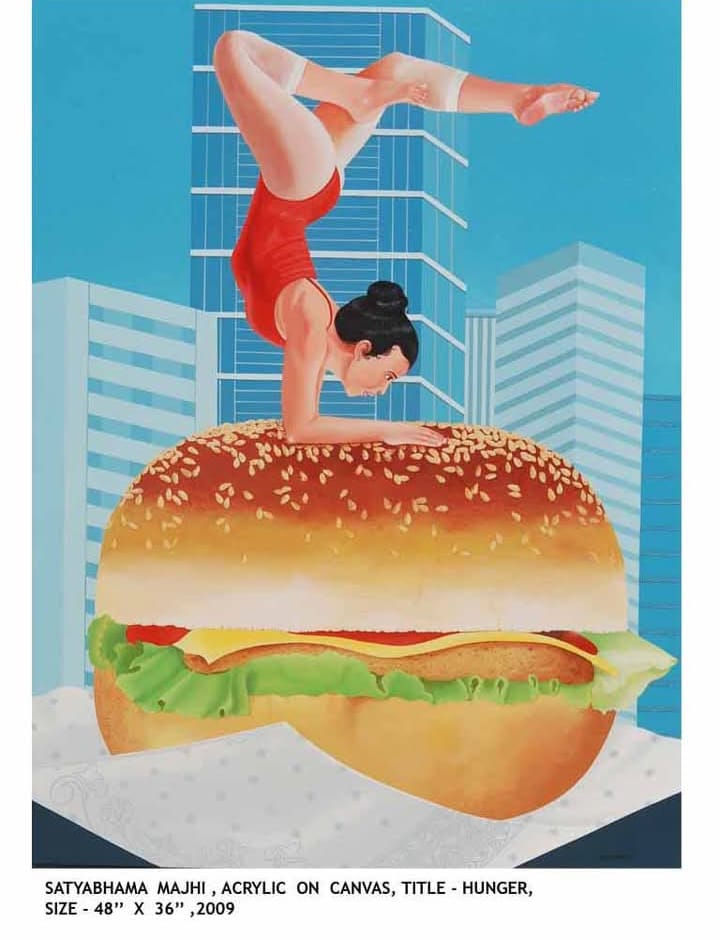
Observation of modernity — examining urban expansion, popular culture and changing lifestyles.
Community experience — bringing ordinary people into the centre of contemporary visual art.
Through these elements, her paintings often appear simultaneously intimate and expansive.
A single figure can tell one story.
But dozens of figures together begin to tell the story of a society.
Selected Career Highlights
2023 — People’s Wall, New Parliament House
Co-Sutradhar and key creative contributor to “People’s Wall – Jan, Janani and Janmabhumi,” a participatory initiative involving women artists and artisans from across India, realized for the New Parliament House by Lalit Kala Akademi, New Delhi.
Community & Tribal Engagement
More than a decade of sustained interaction with the Dongaria Kondh community, studying their cultural practices, daily movement, livelihood and relationship with nature.
Art & Child Education
Around fifteen years of engagement with children and schools through art-based creative learning, including work associated with Gram Vikas and Tata Trust.
Public Art
Participation in significant murals and public-art initiatives across Odisha, including projects connected with major sporting and cultural events.
Lalit Kala Akademi State Award
Recipient of the Odisha Lalit Kala Akademi State Award, recorded in her professional profile as 2012.
National Scholarship
Recipient of the National Lalit Kala Akademi, New Delhi Scholarship, 2009–2010.
Major Exhibitions & Platforms
Her career includes engagements with Bharat Bhavan, Nature Morte, Lalit Kala Akademi, Odisha Lalit Kala Akademi, Bhubaneswar Art Trail, Gram Art Project and projects connected with the Vancouver Biennale.
A Practice Rooted in Empathy
At the heart of Satyabhama Majhi’s work is empathy.
Her professional profile describes her artistic and community efforts as a process of developing better relationships with nature, oneself, other people and the surroundings.
That belief connects seemingly different aspects of her life.
Her urban paintings.
Her Dongaria Kondh studies.
Her natural pigments.
Her public murals.
Her work with children.
Her curatorial engagements.
Her tribal documentation.
They are all part of the same larger enquiry:
How can art bring people closer to the worlds they often fail to notice?
Beyond the Gallery
For Satyabhama Majhi, the value of art is not determined only by where it is exhibited.
An artwork inside a respected institution can be important.
But so can a painting created by a child in a remote school.
So can a mural transforming a neglected neighbourhood wall.
So can a naturally sourced pigment gathered from a hill.
So can an indigenous visual symbol passed from one generation to another.
And so can a national participatory artwork bringing together women artisans from across India.
Her career demonstrates that contemporary art can exist simultaneously within galleries, public spaces, classrooms, villages, tribal landscapes and national institutions.
Artistic Philosophy
Satyabhama Majhi's artistic philosophy can perhaps be understood through four interconnected ideas:
Memory
Every place contains histories that can disappear when environments change.
Community
Art becomes richer when people participate in its creation and interpretation.
Nature
Human culture cannot be fully understood without understanding its relationship with the environment.
Continuity
Tradition does not have to remain frozen in the past; it can enter contemporary artistic conversations without losing its meaning.
These principles allow her work to move between past and present, village and metropolis, personal observation and collective experience.
Legacy and Continuing Journey
Satyabhama Majhi belongs to a generation of contemporary Indian artists whose practices expand the definition of what an artist can be.
She is a painter, but her work goes beyond painting.
She is a curator, but her interests go beyond exhibitions.
She is a community practitioner, but her engagement goes beyond temporary interventions.
Her artistic journey has become a sustained conversation between art and society.
From watching the changing rhythms of a Bhubaneswar marketplace to exploring the hills of Niyamgiri; from working with school children to collaborating with tribal communities; from transforming public walls in Odisha to contributing to an artistic initiative within India's New Parliament House, each stage of her journey reflects the same fundamental curiosity about human beings and the environments they create.
Her work reminds us that culture survives not only inside archives and museums.
It survives in a painted wall.
In the colours of the soil.
In a marketplace remembered from childhood.
In the movement of people across a hill.
In a child's first confident drawing.
In the hands of an artisan carrying inherited knowledge.
And in an artist willing to observe all of these things with patience.
Satyabhama Majhi’s art ultimately stands at the meeting point of memory, landscape, community and change.
Through more than two decades of artistic practice, she has continued to demonstrate that art can do more than represent the world.
It can help us notice it.
It can help us remember it.
And, at its most meaningful, it can help us care for it.
SATYABHAMA MAJHI
Contemporary Indian Artist • Curator • Social Activist • Community Art Practitioner
Based in Bhubaneswar, Odisha, India
Painting people. Preserving memory. Connecting communities. Celebrating the living relationship between art, culture and nature.
album